Where Art Lives by the Sea – Zadar’s Soul in Every Corner
You know that feeling when a city just gets you? Zadar, Croatia, hit me like a wave—literally and artistically. Forget cookie-cutter European towns; this coastal gem blends ancient stones with living art in ways I never expected. From sea-powered melodies to sunsets that feel choreographed, Zadar doesn’t just display art—it breathes it. Perched along the shimmering Adriatic coast, this historic city has transformed its scars from war and time into a canvas of innovation and soul. I’ll take you through the theme areas where creativity meets the sea, and why this city should be on every culture lover’s radar.
The First Glimpse: Where History Meets Modern Art
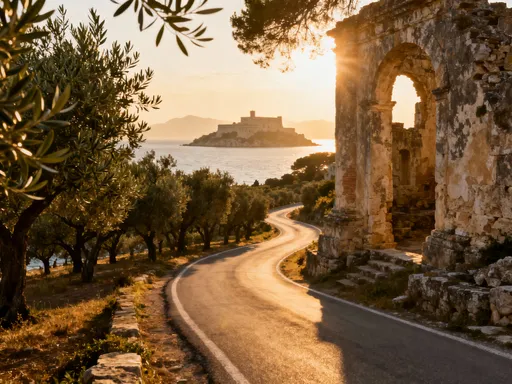
Arriving in Zadar, one is immediately struck by the harmony between old and new—a balance rarely achieved with such grace. The city’s roots stretch back over 3,000 years, from Illyrian settlements to Roman prominence and medieval ecclesiastical influence. Today, remnants of that layered past—stone fortifications, cathedral ruins, narrow cobbled lanes—are not preserved behind velvet ropes but lived in, walked upon, and reimagined. Unlike many historic European cities that treat contemporary art as an afterthought or a tourist gimmick, Zadar integrates modern installations into its daily rhythm, making creativity feel not like an exhibit but a natural extension of civic life.
The Five Wells Square, originally constructed in the 15th century as part of the city’s defense and water supply system, now serves as an open-air stage during summer months. What once echoed with the footsteps of guards and the splash of bucket-drawn water now resonates with live music, dance performances, and community gatherings. This transformation honors the site’s function while redefining its purpose—a model of adaptive reuse that respects history without being trapped by it. The surrounding stone walls, pockmarked by time and cannon fire, frame temporary art displays that shift with the seasons, ensuring that the square remains dynamic rather than static.
Along the Riva—the city’s seaside promenade—this dialogue between epochs becomes even more vivid. Sleek metal sculptures stand in quiet conversation with weathered stone balustrades. One moment you’re admiring a 12th-century church bell tower, the next you’re drawn to a minimalist steel figure gazing out at the sea. These juxtapositions are not accidental but intentional, part of a broader urban vision to weave art into the fabric of public space. The city planners and artists behind Zadar’s revival understood that preserving history does not mean freezing it in time. Instead, they chose to let the past breathe, to evolve, and to invite new voices into the narrative.
What makes Zadar’s approach unique is its commitment to accessibility. Art here isn’t confined to galleries or elite circles. It’s embedded in sidewalks, tucked into corners, and activated by the public. A child might climb on a bronze sculpture without knowing the artist’s name, a couple might kiss beneath a light installation without realizing its technical complexity—yet both are engaging with art on a human level. This democratization of creativity is perhaps Zadar’s greatest achievement: it reminds us that beauty and meaning belong to everyone, not just those who know how to interpret them.
The Sea Organ: Nature and Music in One Breath
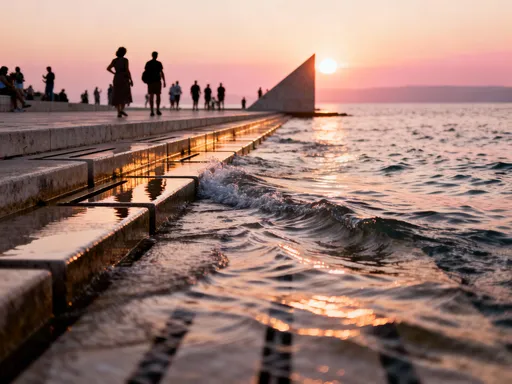
Among Zadar’s many wonders, the Sea Organ stands as a masterpiece of poetic engineering. Built into the stone steps that descend into the Adriatic, this installation transforms the ocean’s movement into haunting, ever-changing melodies. Designed by Croatian architect Nikola Bašić and completed in 2005, the Sea Organ is not played by human hands but by the breath of the sea itself. As waves rise and fall, they push air through a network of 35 polyethylene tubes buried beneath the stairs. Each tube is tuned to a different musical chord, and as the pressure shifts, harmonies emerge—sometimes soft and meditative, other times bold and resonant.
The result is not a composed symphony but an organic composition, unique to every moment. There is no conductor, no score, no repetition. One evening might bring a minor key lament, the next a playful arpeggio. Locals often sit on the warm stone steps, eyes closed, letting the sound wash over them like the tide. Tourists, initially skeptical, lean in closer, trying to discern the pattern—only to realize there isn’t one. And that’s the point. The Sea Organ doesn’t perform for you; it invites you to listen, to pause, to become part of the experience.
Bašić’s vision was rooted in the idea of reconnecting people with nature through art. In a world saturated with digital noise and artificial stimulation, the Sea Organ offers something rare: a moment of unplanned beauty, born from natural forces. It is also a tribute to Zadar’s resilience. Built on the site of a former parking lot that replaced war-damaged buildings, the installation symbolizes renewal—not by erasing the past, but by transforming it into something meaningful. The sea, which once brought destruction through bombardment, now brings music.
Acoustically, the Sea Organ is a marvel. The tubes are arranged in seven columns, each corresponding to a musical interval, and the sounds are channeled through openings in the stone that resemble organ pipes. The pitch and volume depend on the intensity of the waves, meaning the music changes with the weather, the season, and even the time of day. On stormy nights, the organ produces deep, resonant tones that vibrate through the ground. On calm afternoons, the notes are delicate, almost whispering. This unpredictability is what gives the piece its emotional power. It cannot be replicated, recorded, or controlled—and in that lies its authenticity.
The Greeting to the Sun: A Daily Light Ritual
Just a short walk from the Sea Organ, another of Bašić’s creations awaits: the Greeting to the Sun. This 22-meter diameter installation, embedded in the promenade, is a celebration of light, energy, and cosmic connection. By day, it appears as a subtle circle of glass panels, nearly flush with the surrounding stone. But as dusk falls, it awakens. Using energy collected from 300 square meters of photovoltaic cells beneath its surface, the installation begins to glow, pulsing with rhythmic patterns of blue, green, purple, and gold.
The light sequence is not random. It is designed to mimic the movement of the solar system, with concentric rings lighting up in waves that echo planetary orbits. At the center, a smaller ring represents the Earth, surrounded by bands that rotate at different speeds, symbolizing the dance of celestial bodies. As the display evolves, it draws people in—children point and laugh, couples hold hands, elderly visitors sit on nearby benches, mesmerized. It is not just a light show; it is a shared ritual, a daily reminder of humanity’s place in the universe.
The Greeting to the Sun is more than an artistic statement; it is a functional piece of sustainable design. By harnessing solar energy, it operates entirely off-grid, embodying Zadar’s commitment to environmental responsibility. The same sun that warms the Adriatic by day powers this nocturnal spectacle, closing a loop of natural harmony. This integration of art and ecology is emblematic of the city’s broader philosophy: that beauty and function need not be separate.
For many visitors, this moment—standing between the Sea Organ and the Greeting to the Sun as night falls—is the emotional peak of their Zadar experience. The sound of the waves harmonizing with the organ, the sky painted in hues of orange and pink, the ground beneath glowing like a captured starfield—it feels orchestrated, even sacred. There are no announcements, no schedules, no tickets. The ritual happens every evening, open to all, free of charge. In a world where so much is monetized and curated, this simple, recurring wonder feels like a gift.
Art in the Urban Fabric: Murals, Mosaics, and Hidden Corners
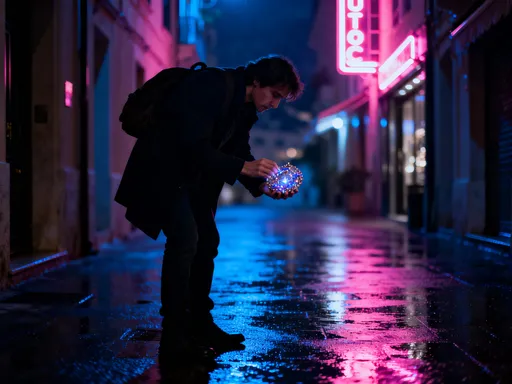
Beyond the iconic installations, Zadar’s artistic soul reveals itself in quieter, more intimate ways. Turn down a narrow alley off the main square, and you might stumble upon a vibrant mural depicting a fisherman’s tale in bold geometric shapes. Peek into a church courtyard, and you’ll find an abstract mosaic made from broken tiles, its colors echoing the sea and sky. Even the city’s storm drains are adorned with custom metal grates shaped like octopuses, seahorses, and starfish—small touches that signal a deep respect for craftsmanship and imagination.
These details are not the work of a single artist or institution but the cumulative expression of a community that values creativity in all its forms. During the Yugoslav era, public art was often used as a tool for political messaging, and remnants of that period can still be seen in the bold, socialist-realist murals that adorn some building facades. Today, these pieces are not erased but preserved as historical artifacts, their meanings reinterpreted by new generations. In some cases, contemporary artists have painted over them with new layers, creating palimpsests of time and ideology.
One of the most touching examples of this layered artistry is the Church of St. Donatus, a 9th-century Byzantine structure that now hosts sound and light installations during festivals. The contrast between the ancient round building and the modern projections on its stone surface creates a powerful visual metaphor: tradition and innovation are not enemies but collaborators. Similarly, repurposed military bunkers along the coast have been transformed into pop-up galleries, where local artists display paintings, sculptures, and mixed-media works. These spaces are temporary, spontaneous, and deeply personal—exactly the kind of art that thrives outside institutional walls.
For the attentive traveler, Zadar rewards slow exploration. There is no rush here, no checklist of must-see sights. Instead, the city invites wandering, noticing, and discovering. A hand-painted sign on a café door, a ceramic tile embedded in a wall, a poem etched into stone—each is a small act of love, a declaration that beauty matters. This is not art for Instagram likes or tourist brochures. It is art for the people who live here, who walk these streets every day, who find joy in the details.
Cultural Spaces: Museums and Galleries with a Local Pulse
While Zadar’s outdoor art captures the imagination, its indoor institutions provide depth and context. The Museum of Ancient Glass, housed in a restored Benedictine convent, is a standout. Its collection spans over 2,000 years, from Roman perfume bottles to medieval chalices, each piece telling a story of craftsmanship, trade, and daily life. What sets the museum apart is its tactile approach—visitors are encouraged to touch replicas, examine fragments under magnifying glasses, and even try their hand at glassblowing during workshops. This hands-on philosophy makes history feel immediate and personal.
Equally compelling is the Gallery of Fine Arts, located in a 16th-century palace in the heart of the old town. Unlike large national museums that can feel impersonal, this gallery focuses on Croatian artists from the 14th century to the present, with an emphasis on Dalmatian creators. Rotating exhibitions ensure that no two visits are the same, and the curators often pair historical works with contemporary pieces, creating dialogues across time. A Baroque religious painting might hang beside a modern abstract interpretation of the same theme, inviting reflection on how beliefs and expressions evolve.
Smaller spaces, like the Kalelarga Gallery and the Rector’s Palace Exhibition Hall, offer even more intimacy. These venues host temporary shows by emerging artists, experimental installations, and community-driven projects. Admission is often free or by donation, reinforcing the idea that art should be accessible, not exclusive. Some exhibitions are interactive—inviting visitors to contribute drawings, write poems, or leave messages—turning passive viewers into active participants.
What unites these institutions is their connection to place. They do not merely display art; they tell Zadar’s story. From the maritime heritage reflected in nautical motifs to the influence of Mediterranean light on color palettes, the works on display are rooted in local experience. This authenticity resonates with visitors, especially those seeking more than surface-level tourism. In a world of generic museum gift shops and mass-produced souvenirs, Zadar’s cultural spaces offer something rare: truth.
Festivals and Seasonal Art: When the City Comes Alive
Art in Zadar is not static—it pulses with the rhythm of the seasons. Summer transforms the city into an open-air stage, where the Roman Forum, once the center of civic life, becomes a venue for concerts, theater performances, and dance. The stone ruins, illuminated at night, provide a dramatic backdrop for everything from classical music to contemporary installations. One evening, you might hear a violinist playing Vivaldi beneath the stars; the next, a digital projection might turn the cathedral façade into a canvas of moving water and fire.
The annual Art Zadar festival is a highlight, drawing artists, curators, and creatives from across the region. For ten days, the city becomes a laboratory of expression—pop-up studios appear in abandoned buildings, street performers animate quiet squares, and guided tours reveal hidden artworks known only to locals. The festival emphasizes participation, offering workshops in mosaic-making, printmaking, and sound art. Families, couples, solo travelers—all are invited to create, not just consume.
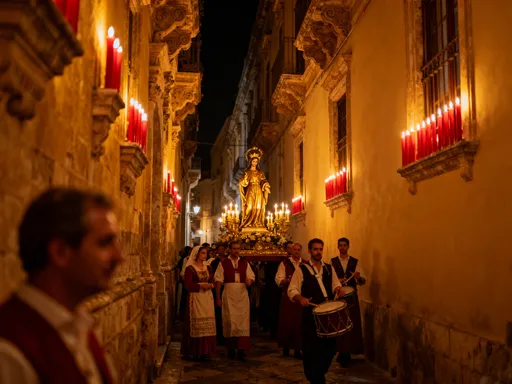
Even in the shoulder seasons, Zadar maintains its cultural momentum. The International Choir Festival in spring fills churches with polyphonic singing, a tradition dating back centuries. Autumn brings the Festival of the Sea, celebrating maritime heritage through boat parades, seafood markets, and art installations made from recycled ocean materials. These events are not tourist spectacles but community celebrations, rooted in local identity and pride.
For visitors, timing a trip around these festivals can transform a simple getaway into a meaningful encounter. There is a difference between seeing a city and feeling it—and festivals offer that emotional connection. To stand in the forum during a light show, surrounded by locals and travelers alike, all silent in awe, is to experience Zadar not as a destination but as a living, breathing entity. The boundaries between artist and audience, resident and visitor, blur—and in that space, something beautiful emerges.
Why Zadar’s Art Matters: A Model for Sustainable Cultural Tourism
Zadar’s artistic revival offers more than aesthetic pleasure; it provides a blueprint for how cities can heal, innovate, and thrive without sacrificing authenticity. After the devastation of World War II and the Yugoslav wars, Zadar could have chosen to rebuild with generic concrete or cater solely to mass tourism. Instead, it invested in creativity as a form of civic renewal. The Sea Organ, the Greeting to the Sun, the murals, the festivals—none of these required celebrity architects or billion-dollar budgets. They required vision, courage, and a belief that art belongs to the people.
This model of cultural tourism is sustainable in every sense. Environmentally, installations like the solar-powered light circle reduce energy dependence. Economically, local artists, craftsmen, and small businesses benefit from increased cultural interest. Socially, public art fosters community pride and intergenerational connection. And culturally, Zadar avoids the trap of becoming a museum piece—frozen in time for tourists to gawk at. Instead, it remains a living city, evolving while honoring its roots.
Other destinations can learn from Zadar’s example. Too often, cities “add” art as decoration—a statue here, a mural there—without integrating it into the urban experience. Zadar shows that when art is woven into infrastructure, when it serves both beauty and function, when it is created *with* the community rather than *for* tourists, it becomes transformative. It changes how people move through space, how they interact, how they feel.
In a world where travel can feel transactional—book a hotel, check a landmark, take a photo, move on—Zadar invites slowness, presence, and connection. It asks not just that you look, but that you listen to the sea’s song, feel the warmth of the sun’s glow, and notice the small details that others might miss. It reminds us that art is not a luxury but a necessity—a way of making sense of the world, of finding wonder in the everyday.
Zadar’s art isn’t confined to galleries. It sings through the waves, glows under moonlight, and hides in alleyways waiting to be discovered. More than aesthetics, it reflects a philosophy: that beauty should be shared, not locked behind ropes. In a world of crowded landmarks, Zadar invites us to slow down, listen, and feel. If you’re seeking a destination where art isn’t just seen but lived—this is it.