This Is Hiroshima’s Artistic Soul — You’ve Never Seen Architecture Like This
Hiroshima isn’t just a city of history—it’s a living canvas of architectural emotion. From serene traditional homes to bold modern structures, every building tells a story of resilience and creativity. I walked its streets, camera in hand, stunned by how design here blends memory, nature, and innovation. This is not just reconstruction—it’s rebirth through art. Let me take you where steel beams meet soul.
The Quiet Beauty of Shukkei-en: Where Nature Becomes Architecture
Shukkei-en, a 17th-century strolling garden nestled in the heart of Hiroshima, stands as one of Japan’s most poetic expressions of landscape architecture. Originally constructed in 1620 for the feudal lord Asano Nagaakira, this six-acre retreat embodies the Japanese principle of shakkei, or 'borrowed scenery,' where distant mountains and sky are seamlessly woven into the garden’s composition. Unlike Western gardens that often impose form on nature, Shukkei-en dissolves the boundary between the built and the natural. Its stone paths curve gently around ponds shaped like crane and turtle islands—symbols of longevity—while arched bridges frame views like living paintings. Every element is placed with intention, not for ornament, but for harmony.
The garden’s small pavilions—such as the Moon-Viewing Hall and the Plum Blossom Retreat—are not grand structures, yet they possess architectural dignity. Built from wood, paper, and tile, they reflect the wabi-sabi aesthetic: beauty in imperfection, transience, and simplicity. Their sliding doors open entirely to the garden, erasing the separation between interior and exterior. In spring, cherry blossoms drift onto the water; in autumn, maples ignite in red and gold, their reflections trembling on the surface. The architecture here does not dominate—it listens, responds, and recedes, allowing nature to speak.
What makes Shukkei-en truly unique is its survival. Though much of Hiroshima was destroyed in 1945, the garden’s layout and many of its elements endured. Restoration efforts honored original techniques, using hand-split timber and traditional joinery. Today, visitors walk the same paths as generations past, experiencing a continuity of peace and contemplation. It is not merely a place to see, but to feel—a sanctuary where architecture becomes a vessel for stillness, memory, and seasonal change.
Modern Resilience: The Hiroshima Peace Memorial Park’s Silent Language
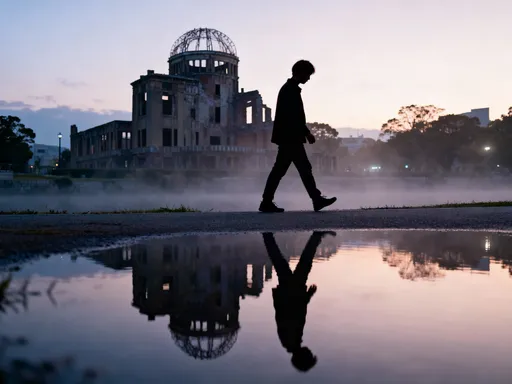
The Hiroshima Peace Memorial Park, spanning 120,000 square meters along the Motoyasu River, is a masterclass in architectural minimalism as a form of emotional expression. Designed by renowned architect Kenzo Tange and completed in 1954, the park is a carefully orchestrated sequence of spaces that guide visitors from shock to reflection to hope. At its center stands the Atomic Bomb Dome, the skeletal remains of the former Hiroshima Prefectural Industrial Promotion Hall. Its twisted iron frame and shattered dome are preserved exactly as they were found after the blast—a decision made in 1966 after years of public debate. This is not ruin as decay, but ruin as testimony.
Tange’s design philosophy was clear: let emptiness speak. The park is laid out on a north-south axis, with the Atomic Bomb Dome aligned with the Peace Memorial Museum and the Cenotaph for the A-Bomb Victims. The Cenotaph, a simple curved concrete structure resembling a boat, shelters the registry of all known victims. Its arch frames both the Dome and the Peace Flame, creating a visual and symbolic bridge between past and future. There are no loud statements, no dramatic sculptures—only space, light, and silence. Visitors walk on wide gravel paths, surrounded by open lawns and rows of zelkova trees, their canopies offering shade and a sense of order amid chaos.
The emotional power of the park lies in its restraint. Unlike war memorials that glorify sacrifice, this space mourns loss without anger. The architecture does not shout; it whispers. Schoolchildren lay paper cranes at the Children’s Peace Monument, inspired by the story of Sadako Sasaki, who folded over a thousand before succumbing to radiation sickness. The annual Peace Memorial Ceremony on August 6th fills the park with silence at 8:15 a.m., the exact moment the bomb fell. In this place, architecture is not about form—it is about absence, memory, and the fragile hope for peace.
Everyday Elegance: Traditional Machiya Houses in Hidden Neighborhoods
Away from the grand landmarks, Hiroshima’s residential neighborhoods reveal a quieter form of architectural beauty: the traditional machiya, or wooden townhouse. These narrow, two-story homes, once common across Japan, are now rare in most cities due to urban renewal and fire codes. Yet in districts like Naka-ku and Minami-ku, clusters of machiya survive, their latticed wooden facades and gray tiled roofs offering a glimpse into pre-war urban life. Typically no more than four meters wide, these homes maximize space with vertical design—living areas on the first floor, sleeping quarters above, and small inner courtyards that bring in light and air.
The craftsmanship is subtle but profound. Wooden beams are joined without nails, using interlocking joints that allow the structure to flex during earthquakes. Lattice windows, called koshi, provide privacy while filtering sunlight into soft patterns. Some homes still feature amado, heavy wooden storm shutters that slide into grooves at the front, transforming the house from closed fortress to open living space. Though many have been updated with modern kitchens and bathrooms, their essential character remains—a testament to adaptive reuse and cultural continuity.
Walking these streets feels like stepping into a different era, yet life here is fully contemporary. A machiya might house a family, a small tea shop, or a boutique selling handmade crafts. In some cases, owners have opened their homes as guesthouses, offering visitors a rare opportunity to sleep within centuries-old wood. These neighborhoods are not museums; they are lived-in, evolving spaces where tradition and modernity coexist. The machiya represent a form of architectural humility—buildings designed not to impress, but to serve, endure, and belong.
Contemporary Visions: The Prefectural Art Museum and New Urban Design
The Hiroshima City Museum of Contemporary Art, opened in 1989, stands as a bold statement of cultural rebirth. Located in the Asa area, the museum was designed by architect Fumihiko Maki, a Pritzker Prize laureate known for his fusion of modernism and Japanese sensibility. The building features clean geometric forms—cubes, cylinders, and sweeping curves—arranged around a central courtyard. Natural light floods the interior through skylights and glass walls, illuminating rotating exhibitions of international and Japanese artists. Unlike museums that hide art behind厚重 walls, this one invites the outside in, with terraces that overlook the surrounding hills and seasonal gardens.
Maki’s design reflects a key theme in Hiroshima’s modern architecture: transparency. Glass, steel, and white concrete dominate, creating spaces that feel open, accessible, and forward-looking. The museum’s layout encourages exploration, with ramps and open galleries that avoid rigid hierarchies. Permanent collections include works by Tadanori Yokoo and Yayoi Kusama, artists who grapple with memory, identity, and transformation—themes deeply resonant with the city’s history. Educational programs and community events further anchor the museum as a living institution, not just a repository of art.
Beyond the museum, Hiroshima’s urban design embraces green integration and pedestrian-friendly planning. Wide boulevards, tree-lined plazas, and bike lanes reflect post-war ideals of openness and accessibility. Public buildings often incorporate water features, rooftop gardens, and solar panels, blending sustainability with aesthetic clarity. The city’s tram system, one of the few to survive the bombing, connects old and new districts, offering a slow, human-scale way to experience the city. In Hiroshima, contemporary architecture does not erase the past—it dialogues with it, offering forms that are both modern and mindful.
Rebuilding with Purpose: How Post-War Planning Shaped Today’s Cityscape
The reconstruction of Hiroshima after 1945 was not merely an act of rebuilding—it was an act of reimagining. With over 90% of the city center destroyed, urban planners had a rare opportunity: to design a city from the ground up, not just for function, but for meaning. The 1949 Hiroshima Peace Memorial City Construction Law mandated that the city be rebuilt as a symbol of peace, with wide streets, abundant green spaces, and civic institutions at its core. Influenced by garden city principles, the plan prioritized human scale over monumentality, accessibility over exclusivity.
One of the most visible legacies is the network of broad avenues radiating from the hypocenter. These were designed not only to prevent fire spread—a lesson from the bombing—but also to create open, breathable spaces in contrast to the dense pre-war city. The Peace Boulevard, lined with zelkova trees and bicycle paths, serves as both a transportation corridor and a ceremonial route. Green belts and parks were integrated throughout, ensuring that nature would always be within reach. The city’s zoning encouraged mixed-use development, allowing homes, shops, and offices to coexist in harmony.
This planning philosophy reflected a deeper ethos: that a city should heal, not just house. Public spaces were designed to encourage gathering, reflection, and dialogue. The reconstruction was not rushed; it was deliberate, involving input from citizens, architects, and peace advocates. Today, Hiroshima’s urban fabric bears the imprint of that vision—a city that values openness, resilience, and human connection. It stands as a model of how urban design can be an expression of collective hope.
Hidden Gems: Offbeat Galleries and Architectural Surprises in Side Streets
Beyond the well-trodden paths, Hiroshima’s creative spirit thrives in unexpected corners. In the backstreets of Kamiyacho and Ekimae, small galleries and artist studios occupy repurposed buildings—former warehouses, old schools, even disused banks. One such space is the Fukuromachi Gallery, housed in a renovated 1950s brick building that once served as a municipal office. Its raw interiors, exposed beams, and large windows provide a stark yet warm backdrop for contemporary photography and installation art. Another gem is the Paper Crane Café, where a retro Showa-era house has been transformed into a cozy coffee shop with a rooftop garden and rotating art exhibits by local women artists.
These spaces exemplify Hiroshima’s culture of adaptive reuse. Instead of demolishing the old, the city often finds new life in it. A former sake brewery in the Asaminami district now hosts ceramic workshops and seasonal markets. Abandoned tram depots have been converted into community art centers. These transformations are not driven by commercial trends, but by a grassroots desire to preserve memory while fostering creativity. They are intimate, personal, and often run by individuals or small collectives who see architecture not as static, but as evolving.
Exploring these hidden spots offers a different perspective on Hiroshima—one that is not defined by tragedy, but by quiet reinvention. They are places where conversation flows easily, where art is accessible, and where the architecture itself feels welcoming. For visitors, they provide a chance to connect not just with the city’s past, but with its living present.
Design That Breathes: Why Hiroshima’s Architecture Feels So Alive
What unites Hiroshima’s diverse architectural expressions—from Edo-period gardens to modern museums—is a shared philosophy: that design should serve the human spirit. Unlike cities where architecture competes for attention, Hiroshima’s buildings often recede, creating space for reflection, connection, and peace. This is not passive design, but intentional—shaped by history, guided by memory, and rooted in nature. The city’s architecture does not impose; it invites. It does not shout; it listens.
The interplay of resilience and serenity is everywhere. In the preserved ruin of the Atomic Bomb Dome, steel and stone speak of survival. In the flowing lines of Shukkei-en, water and wood whisper of continuity. In the quiet machiya homes, generations live within the same wooden frames, their lives woven into the grain. Even the modern buildings, with their glass and light, feel grounded, not alien. They are not monuments to progress, but to healing.
Hiroshima teaches us that architecture can be more than shelter. It can be a form of memory, a language of peace, a quiet act of hope. In a world where cities grow taller and faster, this city reminds us to build slowly, thoughtfully, with care. It shows that beauty can rise from sorrow, and that every beam, brick, and garden path can carry meaning. To walk through Hiroshima is not just to see buildings—it is to feel the pulse of a city that chose to rebuild not just its structures, but its soul.
Hiroshima’s architecture is not just about buildings—it’s about meaning shaped in wood, steel, and stone. It teaches us that beauty can rise from sorrow, and design can be a quiet act of hope. In a world rushing forward, this city reminds us to build not just for function, but for the soul.